

The full moon hung fat and silver over San Clemente as veteran surfer and writer Sam George pulled into the Trestles trailhead just before midnight. He’d come chasing the oldest dream in surfing—an empty lineup at one of California’s most crowded waves. What he found instead was a lesson every surfer eventually learns: the tribe thinks alike, even in the dark.
The parking lot told the story before he ever touched sand. Cars. Too many cars. And down on the berm, three teenagers sat watching the moonlit walls peel through, their silhouettes proof that the secret was already out.
Why Night Surfing Calls to Us
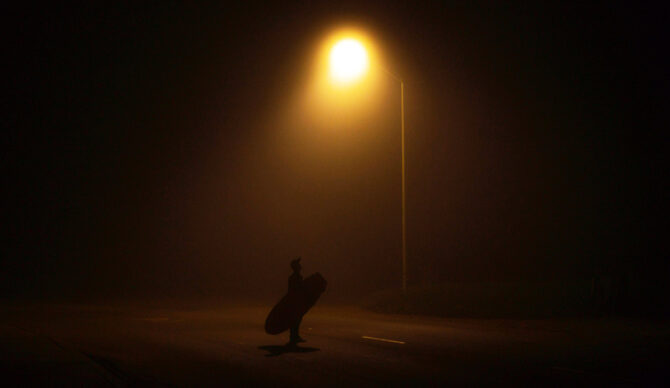
There’s a particular magic that pulls surfers toward the water after dark. It’s not just about dodging crowds—though that’s always part of the calculus. It’s something deeper, more primal. The ocean at night becomes a different creature entirely.
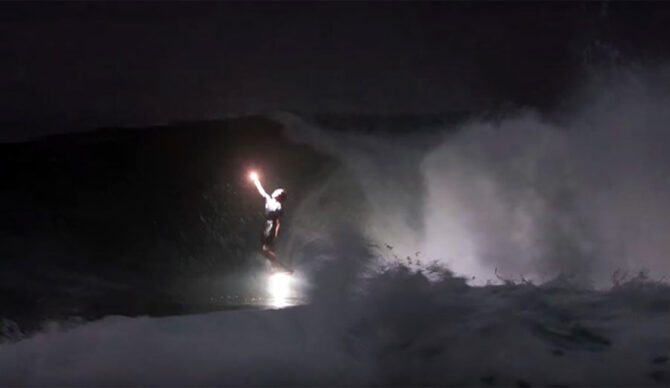
Without daylight’s familiar reference points, everything changes. Peripheral vision collapses. The wave rushing toward you seems faster, more urgent. Your focus sharpens to a laser point because survival demands it. The sensory deprivation paradoxically heightens every sensation—the hiss of water across fiberglass, the cold shock of spray, the sudden lift as the wave takes you.
George knows this feeling intimately. His night-surfing resume reads like a bucket list: Queens in Waikiki back in 1972, the streetlights of Kalakaua Avenue painting the empty lineup gold at 10 p.m. Rincon during a bioluminescence event, where every turn threw glowing green sparks into the darkness. Sandy Lane in Barbados under nothing but starlight. Scorpion Bay’s Third Point with a full moon illuminating those perfect Mexican walls. Playa Vernao in Panama, where the bioluminescent bloom was so thick the whitewater looked radioactive.
Each session carried its own particular beauty. Each promised—and delivered—the solitude that daytime surfing at popular breaks rarely offers. Lower Trestles, George figured, would be no different.
He figured wrong.
The Midnight Session at Lower Trestles
Lower Trestles isn’t just another California beach break. It’s an apex predator of a wave—a world-class cobblestone point that has hosted championship events and produced career-defining footage. It’s also a geographical bottleneck, a peak where takeoff zones compress tightly and surfers stack like rush-hour commuters waiting for the same train.
During daylight hours, the lineup regularly swells past thirty bodies. Elite competitors jostle with weekend warriors. Clean, makeable waves become obstacle courses. Even top-tier surfers struggle to complete unobstructed maneuvers when every shoulder hosts someone dropping in.
George had surfed Trestles countless times during his years living in San Clemente. He understood the dynamics. The midnight session was supposed to be the antidote—a full moon, favorable conditions, and presumably empty water.
But when he crested the berm and looked out at the peak, approximately fifteen surfers were already clustered on the takeoff zone. Fifteen. At midnight.
The math was brutal. These weren’t lost tourists or confused beginners. These were locals, competitors, dedicated wave-hunters who’d all made the same calculation George had made. Escape the daylight chaos. Surf under the moon. Score empty perfection.
Instead, they’d simply transported the chaos into darkness.
A set appeared on the horizon, black lines stacking against the silver-lit sky. The pack immediately began jockeying. Paddles dug. Boards swung for position. And then someone shouted what every surfer shouts when claiming a wave:
“Got it!”
What followed was chaos distilled. Multiple surfers dropped in simultaneously from both sides of the peak. From George’s position on the shoulder, it was impossible to determine who actually had priority. The darkness swallowed the usual visual cues—hand signals, eye contact, the subtle body language that governs lineup etiquette in daylight.
Someone got snaked. Maybe multiple someones. In the dark, accountability vanishes. Frustration has nowhere to land.
George watched one more set arrive, one more scramble unfold, then turned his board toward shore.
Crowds Find the Dark Too
The uncomfortable truth is that surfers are predictable creatures. We share the same apps, the same forecasts, the same mental playbooks. When swell fills in and conditions align, we converge like migrating birds on the same handful of premium breaks.
Night surfing was supposed to be the loophole. The dedication filter. Surely most people wouldn’t bother with the hassle—the trail walk in darkness, the heightened risk, the logistical complications of surfing when you can barely see.
But “most people” still leaves plenty of diehards. And at a wave like Lower Trestles, diehards are the default population. These are surfers who will do whatever it takes to score. If that means midnight sessions under a full moon, so be it.
The irony cuts deep. Night surfing’s appeal lies in escape from crowds, but as more surfers discover that appeal, the escape disappears. The solution becomes the problem.
Worse, the normal social mechanisms that regulate crowded lineups break down in darkness. Eye contact doesn’t work when you can’t see eyes. Right-of-way becomes guesswork. The shouted “Got it!” carries little authority when the shouter is just another shadow among shadows.
When Night Surfing Works—and When It Doesn’t
None of this means night surfing is a lost cause. George’s decades of after-dark sessions prove it can work beautifully under the right circumstances. The key variables are location and obscurity.
Night sessions at Queens in Waikiki worked because few tourists thought to paddle out at 10 p.m., even with streetlights making it safe. Bioluminescence sessions at Rincon worked because the phenomenon is rare enough that crowds don’t anticipate it. Remote breaks like Playa Vernao worked because they’re already lightly surfed in daylight—after dark, they’re practically private.
Lower Trestles, though? Its quality is too well-known. Its accessibility too convenient. Its regular crowd too committed. The full moon that makes night surfing possible there also makes it obvious. Every experienced local in San Clemente and San Diego looked at the same forecast, saw the same lunar cycle, and made the same decision.
Night-Surf Considerations:
- Know your break intimately. Hazards invisible in daylight become lethal in darkness. Rocks, reefs, currents—you need mental maps, not visual ones.
- Bring a buddy. Emergencies become exponentially more dangerous when no one can see you.
- Understand local rules. Some beaches prohibit night access. Getting cited ruins any session.
- Accept the etiquette ambiguity. If a crowd does show, recognize that normal priority systems may not function. Patience becomes paramount.
- Choose obscurity over quality. That secondary peak the crowds ignore during the day? That’s your night-surf spot. The wave everyone wants stays crowded around the clock.
The Bridge of Sighs
George returned to his truck that night with salt in his hair and resignation in his gut. The tape deck was playing Robin Trower’s Bridge of Sighs, and the title track’s mournful lyrics caught something true:
“The sun don’t shine / The moon don’t move the tides / To wash me clean…”
The moon had moved the tides. It just hadn’t moved the crowd.
The next morning, George was back at Lower Trestles. Daylight this time. The usual chaos, the usual jockeying, the usual compromise between wave quality and wave availability. He paddled out anyway because that’s what surfers do. We return. We adapt. We accept the imperfect conditions because the alternative—not surfing—is unthinkable.
Maybe the real lesson isn’t that night surfing fails, but that certain waves have transcended the old rules entirely. Lower Trestles operates at a different density now, a popularity level that no scheduling trick can defeat. The crowd isn’t avoiding your session. The crowd is your session, whatever hour you choose.
For true solitude, you’ll need to look elsewhere. Lesser-known breaks. Imperfect conditions. Waves that require more sacrifice than a midnight alarm.
The empty lineup still exists. You just won’t find it at an apex peak, no matter how dark it gets.