

The ocean had turned hostile. Somewhere between Bali’s legendary Uluwatu cliffs and the remote jungle barrels of G-Land, Australian downwind foiler Josh Ku found himself utterly alone — separated from his safety vessel, battling currents that seemed intent on swallowing him whole, with 58 miles of open ocean serving as the only witness to what was becoming a fight for survival.
“It was clear this was extremely dangerous and I had bitten off more than I could chew,” Ku would later admit.
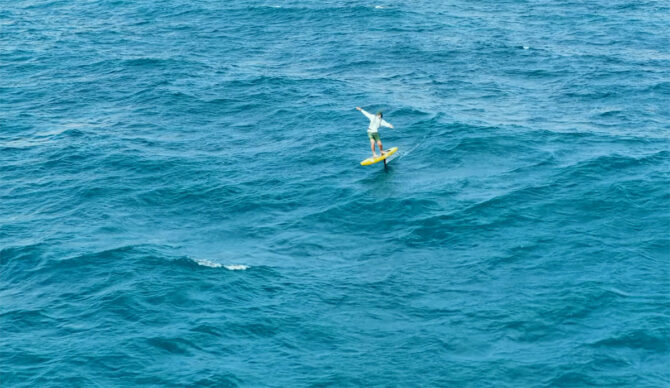
On June 27, 2025, the Australian paddle sports athlete completed what may be one of the most audacious open-ocean crossings in the brief but rapidly evolving history of downwind SUP foiling. The journey — now documented in a gripping short film by Ku and filmmaker Dane Wilson — connects two of surfing’s most storied waves across one of Indonesia’s most treacherous stretches of water.
Two Temples of Surf, Connected by Madness
The route itself reads like a pilgrimage through surfing’s spiritual geography. Uluwatu — Bali’s crown jewel, the wave that helped launch Gerry Lopez into counterculture immortality in the 1970s. And G-Land — Java’s hidden dragon, a remote left-hander accessed through jungle and discovered by intrepid souls like Peter McCabe during the same era of exploration.
For Ku, connecting these two sacred points wasn’t just an athletic challenge. It was an act of reverence.
“Both historic surf spots founded in the ’70s by adventurous surfers such as Gerry Lopez and Peter McCabe,” Ku explained of his motivation. “They inspired me to try something new; something that might not end in a glorious reward but instead end in failure — to trust your gut instinct and have a crack.”
That “crack” would test every ounce of his experience.
Downwind SUP foiling occupies a unique space in the watersports universe — part paddling endurance, part aviation, part ocean reading. The discipline demands that riders harness open-ocean swells, linking bumps of energy to stay aloft on their hydrofoil for miles at a time. There is no motor. No sail. Just a paddle, a board, a foil, and an intimate understanding of how the sea breathes.
“Downwind SUP foiling is one of the most demanding disciplines in watersports, requiring total self-reliance, deep ocean knowledge, and the ability to read constantly changing conditions,” explained Ku and Wilson in their film’s documentation.
The Bali Strait amplifies every one of those demands. Strong currents pulse between the islands. Conditions shift with little warning. The fetch is long enough to build serious seas. For a solo athlete on a foil, it’s the kind of environment where small miscalculations cascade quickly.
When the Ocean Showed Its Teeth
The film’s title pulls no punches: HOW I NEARLY DIED TRYING TO CROSS THE BALI STRAIT ON HYDROFOIL. This wasn’t hyperbole crafted for clicks. By Ku’s own account, the crossing became a masterclass in survival.
“I was dealt a super difficult card being the hardest run I’ve ever done, making the Molokai to Oahu crossing in Hawaii seem like a walk in the park,” Ku reflected. “Battling tough conditions, huge seas, and dangerous currents…”
That comparison carries weight. The Molokai-to-Oahu channel crossing is considered one of paddling’s ultimate tests — a 32-mile gauntlet through notoriously unpredictable Hawaiian waters. For Ku to describe the Bali Strait as significantly harder speaks to conditions that exceeded even worst-case planning.
At some point during the crossing, Ku became separated from his accompanying safety vessel. The exact circumstances and duration of the separation remain details the film explores, but the psychological toll of finding yourself alone in massive seas — miles from either shore — is not difficult to imagine.
The short film by Ku and Wilson captures moments from the harrowing journey, offering viewers a visceral window into both the beauty and terror of pushing limits in open water.
The Philosophy of Rolling the Dice
What drives someone to attempt a crossing where the margin for error is measured in heartbeats? For Ku, the answer connects to something larger than athletic achievement.
“I think it’s important in this day and age that we do kind of roll the dice, because that’s living.”
It’s a statement that will resonate with some and trouble others. The adventure sports community has long grappled with the tension between celebrating boundary-pushing feats and acknowledging the consequences when those boundaries push back.
Ku completed the crossing. He lived to share the story, to release the film, to inspire others in the growing downwind foiling community. But his own words — “bitten off more than I could chew,” “extremely dangerous,” “nearly died” — serve as their own cautionary tale.
A note to readers: Crossings of this nature require years of elite-level experience, extensive safety planning, professional support crews, and conditions expertise that cannot be replicated casually. The Bali Strait presents serious hazards including powerful currents and rapidly changing sea states. This crossing should not be attempted without professional guidance and comprehensive safety protocols.
What It Means for the Sport
The successful Uluwatu-to-G-Land crossing marks another milestone in downwind foiling’s rapid evolution from niche discipline to legitimate ocean adventure sport. As equipment improves and more athletes develop the skillset, we’re likely to see more ambitious channel crossings attempted worldwide.
But Ku’s experience also highlights the sport’s inherent risks. Unlike traditional paddling or even prone foiling, SUP foiling adds height and complexity — a fall at speed in open ocean isn’t just a reset, it’s a potential emergency.
The crossing received surprisingly little attention upon completion, a fact that seems to be changing as the documentary reaches wider audiences. For a feat that bridges two of surfing’s holiest grounds across 58 miles of unforgiving Indonesian ocean, Josh Ku’s journey deserves its place in the conversation about what’s possible when humans, boards, and foils meet the raw power of open water.
Whether that place is cautionary tale or celebration likely depends on who’s listening.