

The air hung heavy with salt and expectation as Dane Henry dropped into a closing section at the World Junior Championships, threading a barrel before launching into the kind of full-rotation aerial that makes judges reach for high scores and rivals question their career choices. When the horn sounded, the 17-year-old from Australia’s Gold Coast had done what no compatriot had managed in years—he’d won a world title and punched his ticket directly into the Challenger Series.
It wasn’t just a victory. It was a statement.
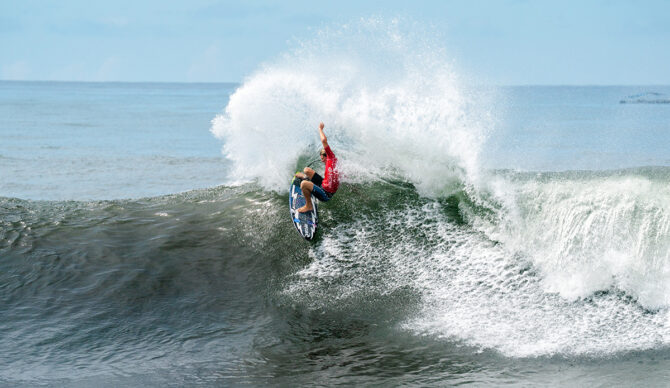
For a nation that once dominated professional surfing like few others, Australia has spent the better part of a decade watching from the beach as Brazilian flags flew on victory podiums. But at this year’s World Juniors, something shifted. Australians filled three of the four men’s semifinal spots and swept all four women’s semifinal positions. The yellow and green wasn’t just present—it was unavoidable.
“This year at the World’s, the Aussies took over, which is pretty sick,” said Lennix Smith, a two-time World Junior semifinalist who’s emerged as one of the cohort’s most vocal leaders.
When asked about Henry’s abilities, Smith didn’t mince words: “Yeah, he’s pretty fucking good.”
The New School: Meet the Cohort
Dane Henry is the headliner, but he’s far from alone. This generation runs deep.
There’s Lennix Smith himself, whose consistency at the junior level—back-to-back semifinal finishes in 2024 and 2025—suggests a surfer built for the grind of professional competition. Vincent Winter and Hughie Vaughan have both emerged as legitimate threats in international junior events, each bringing their own stylistic signatures to the water.
What separates Henry, according to those who’ve competed against him, is his completeness. Smith broke it down after their semifinal heat: “His all-around ability is crazy. In our semi, he milked a one-footer for five points in the last 10 seconds, and got the score. So he can grind as well.”
That’s the mark of a future CT threat—someone who can throw progressive aerials in pumping surf but also scratch out heat wins when the ocean goes flat. It’s the difference between highlight-reel talent and championship-caliber competition.
The contrast with international rivals at this event was stark. Will Deane, the top American performer, bowed out in the Round of 16. The Brazilians, whose senior compatriots have dominated the Championship Tour for over a decade, failed to make significant noise.
The Pathway: Funding, Facilities, and Home-Court Advantage
Talent alone doesn’t win world titles. Infrastructure does.
Australia has rebuilt its competitive surfing pipeline with the kind of systematic investment that transforms potential into podiums. The High Performance Centre in Casuarina—a purpose-built facility on the New South Wales coast—has become the proving ground for the country’s most promising juniors. Government funding flows into development programs at levels that rival any surfing nation on earth.
But the real advantage might be geographic. Three of the seven Challenger Series events are held on Australian soil. The Championship Tour schedule sends roughly one-quarter of its annual stops to Australian beaches. For a young surfer trying to qualify, that’s not just convenience—it’s opportunity.
Henry’s wildcard into the Challenger Series means he’ll get immediate chances to test himself against established professionals, many of those tests coming in familiar waters with home crowds behind him.
“We’re coming at it pretty hard,” Smith said of the collective mindset. “We’re fired up for sure to get back and take on the world again. We just gotta be better at winning and not be losers.”
History and Precedent: The Drought and What Came Before
To understand what this moment means, you have to understand the absence.
Mick Fanning hoisted Australia’s last men’s world title trophy in 2013. That’s more than a decade of watching other nations—primarily Brazil—claim surfing’s ultimate prize. Gabriel Medina, Adriano de Souza, Filipe Toledo, Italo Ferreira, João Chianca. Eight of the last eleven men’s world titles have gone to Brazilian surfers, with only John John Florence interrupting the dominance.
It wasn’t always this way. In the 1970s and 1980s, Australia owned professional surfing. The country produced legends with the regularity of perfect point breaks. Mark Richards. Tom Carroll. Barton Lynch. The attitude was captured by Rabbit Bartholomew back in 1976, as reported by The Inertia’s historical coverage: “The fact is that when you are a young emerging rookie from Australia or South Africa, you not only have to come through the backdoor… but you also have to bust that door down.”
That aggression, that refusal to wait your turn—it defined Australian surfing’s golden era. And it’s the energy this new generation seems determined to resurrect.
The junior-to-senior pipeline has precedent for producing champions. Andy Irons won World Juniors before claiming three CT titles. Joel Parkinson followed the same path. Adriano de Souza and Gabriel Medina both converted junior success into senior dominance.
But the cautionary tales exist too. Finn McGill and Lucas Vicente both won junior world titles and failed to replicate that success at the highest level. The jump from prodigy to professional is littered with promise unfulfilled.
What Comes Next: The Window and the Obstacles
The timing, for once, favors Australia.
Several of the CT’s dominant forces—Medina, Toledo, Ferreira, Chianca—have crossed 30. Injuries have mounted. Retirements loom. The grip these surfers have held on world titles shows signs of loosening, creating space for a new generation to claim.
For Dane Henry, the path forward is concrete: the Challenger Series wildcard puts him directly in the qualification hunt. Strong results there—especially at the Australian stops where he’ll know the lineups intimately—could see him on the Championship Tour within a season or two.
His cohort will follow. Smith, Winter, Vaughan, and others will continue grinding through junior events and regional qualifiers, building the competitive muscle memory that separates those who peak early from those who peak when it matters.
The infrastructure is in place. The talent is undeniable. The historical window is opening.
Whether this generation can actually bust down the door—the way Rabbit demanded, the way Fanning and Parkinson once did—remains the question. But for the first time in years, Australia has surfers capable of asking it.
The yellow and green is coming. And they’re not waiting for an invitation.